
Crafts of Sikkim
Documentation of Handicrafts of Sikkim: In Association with D'Source
Thangka Painting
Also known as thanka, tanka or tangka, Thangka paintings are believed to be originated in Bihar, India. These paintings are complicated but beautiful Tibetan art form. These religious scrolls are hung in monasteries and used as an object for meditation. People also got these paintings made from artists for religious purposes. In the earlier days, monks were the only artists to paint these scrolls. Even now, the artist has to go through a purification process for painting these religious scrolls.
Thang means ‘To see’ and ka means ‘to be happy’. It is believed that one feels happy and peaceful by seeing these scrolls. It is considered lucky to start a painting on Thursday. The painter should enchant the mantra of the deity he is painting. He should pray to the deity to provide him strength to finish the painting and he apologizes if he commits any mistake.
Subjects of these paintings are usually Buddha and stories from his life, other Bodhisattvas and Buddhist teachers and wheel of life. Thangka paintings are framed in a rich colourful brocade and has thin silk cover.
 Stitching up the fabric |  Fixing fabric in the frame |
|---|---|
 Applying chalk paste on the fabric |  Composition in pencil |
 Colours used |  Painting the Sky |
 Painting aasana |  Painting the deity figure |
 Detailing work of fabric of deity |  Correction with knife |
 Painting after cut out |  Thangka framed on silk cloth |
 Tools | 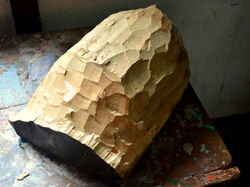 Block of wood for Mask |
|---|---|
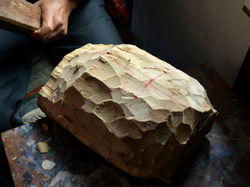 Marking |  Artisan Carving |
 |  Marking Facial Features |
 Carving Eye |  Marking for teeth |
 Carving Teeth |  Ready for Final finishing |
 Painting |  |
 |  Completed Mask |
Mask Making
Serene or angry masks are a common sight in the art and craft shops of Sikkim. These masks are used in ceremonial dancing (Chham) of the lamas in the monasteries. This ancient art was taught only in the monasteries to the lamas in the earlier days. However, now a days, a few local people can also be found making these. Various kinds of masks are prepared for the lama dance, like masks with angry or serene expressions, animal masks or bird masks. Masks are usually made of soft wood or clay mixed with paper pulp.
Hand-Made Paper Making
Handmade Papers, as beautiful and fancy they look; go through a rigorous and long process. In Directorate of Handicrafts and Handloom (DHH), Sikkim, they use the waste material of institute and recycle it to turn it into polished handmade paper. These papers are then used to make different products like note books, lamps, bags etc.
Handmade paper unit was opened in the year 1957 in DHH. Its aim was to maximize the use of by-products of other processes which are usually discarded as waste. This effective method of recycling has resulted in minimum waste production and a better environment.
In last few years, handmade paper products have become quite popular. Apart from being eco-friendly, they provide an artistic look to the products made out of them.
 Waste Paper |  Cutting Cloth Pieces |
|---|---|
 Hollander Beater |  Wet Pulp From Beater |
 Spreading The Pulp In The Mould | 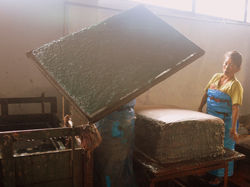 Transferring Pulp on Stacked Sheets |
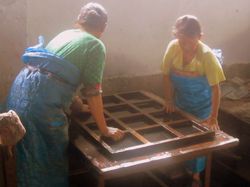 Pressing The Mould |  Cloth After Every Pulp Layer |
 Stacked Sheets Of Pulp |  Hydraulic Pressing Machine |
 Seperating Moist Sheets |  Keeping The Sheets For Drying |
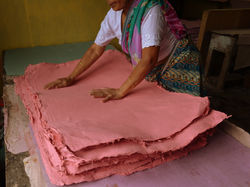 Collecting Dried Sheets |  Removing Foreign Particles |
 Paper Cutting Machine |  Finished Set of Handmade Sheets |
Carpet Weaving
One of the oldest crafts of Sikkim, carpet weaving is practiced mainly by women. The designs weaved in these traditional carpets are Tibetan mythical creatures, lotus, auspicious Buddhist signs, geometrical patterns etc. Customized carpets are also made based on the designs given by the customers. Based on the design and the size of carpet, weaver takes the time to complete the carpet.
Method of weaving that is making knots row after row and the colours used for the yarn is unique in the Sikkim Carpets. Vegetable and natural dyes are still used at places for to obtain the right colour. Designs of these hand woven carpet give a bold and beautiful effect.
 Tools Used |  Sorting the cotton yarn |
|---|---|
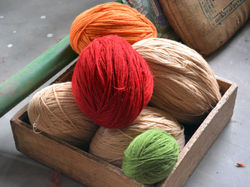 Multi coloured yarn | 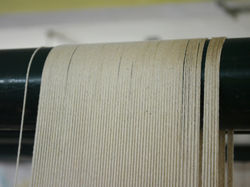 Setting up the loom |
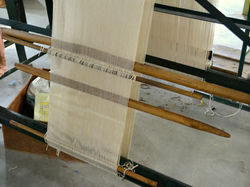 Loom |  |
 |  |
 Knots at the base of the carpet |  Computer Generated Carpet Design |
 Tying knots |  Carpet weaver |
 Spreading the threads evenly |  Finishing carpet with rows of thread |
 Removing the finished carpet |  Finished carpet with the reference |
 Finished Carpets |
Choktse Tables
Anyone who has visited Sikkim must have witnessed the beauty and intricate designs of colourful Tibetan tables called Chokste. Choktse are the small wooden tables originated in Tibet. These foldable and portable tables are intricately carved, polished and painted in bright colours. Various Tibetan motifs like conch shell, infinite knot can be found in the carved designs of these tables.
Choktse is prepared in various parts. The designs to be put in the table are carved out on wood that is mostly cedar or walnut. Frames for the table are prepared. These carved wooden pieces and frames are then assembled together to give the complete product. Similar technique is used to make products like altars, wooden panels, screen partition etc.
 Tools |  Marking |
|---|---|
 Carving The Wooden Pieces |  Finished Wood Carved Pieces |
 Fitting Carved Piece In The Frame |  Creating Foldable Pieces |
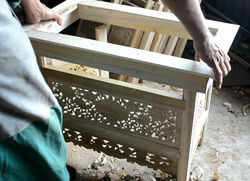 Fixing The Table Top | 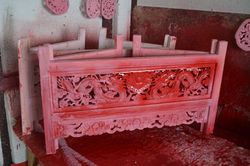 Spray Painting The Base coat |
 Painting The Tops |  Painting the back with flat tones |
 Painting The Details-Primary Coat |  Final Details With Golden Colour |
 Finished Choktse Table |